

Making the Most of Memory: Memory Improvement for Students at Keystone International School

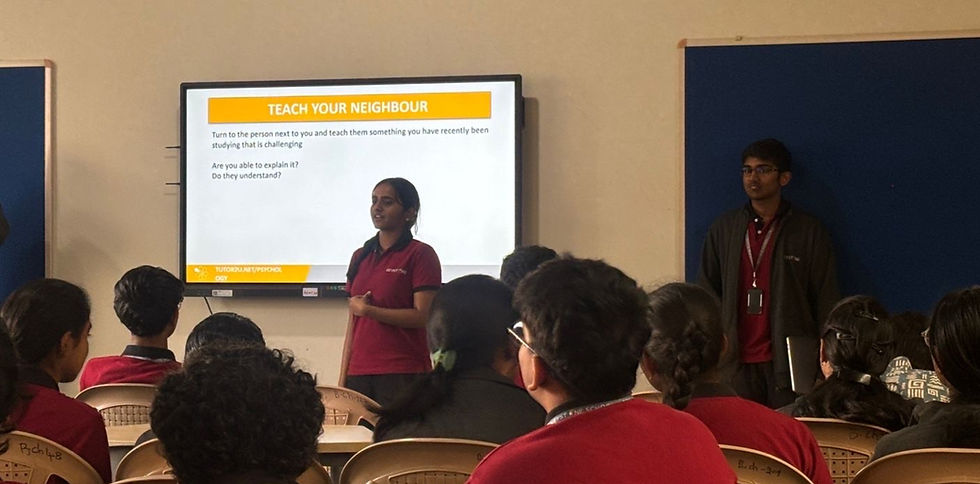
At Keystone International School, learning is designed to go beyond textbooks, encouraging students to take ownership of knowledge and support peer learning.
Continuing this culture of student leadership in schools, Grade 12 learners recently conducted an engaging session titled “Making the Most of Memory”, helping fellow students understand how memory works in learning and how it can be strengthened through practical strategies.
The session combined psychology-backed concepts, interactive demonstrations, and practical study techniques for exams, enabling students to rethink how they prepare, revise, and retain information.
A Student-Led Learning Experience
The session began with a short memory challenge in which students were shown random words and later asked to recall them. Many participants realised how difficult recall becomes without structure or strategy.
This activity led to a discussion on why students forget information and how memory improvement for students can be achieved through smarter study approaches rather than longer study hours.
Through simple explanations, the facilitators demonstrated that memory success is not merely about intelligence or effort but about understanding how information is encoded, stored, and retrieved.
Understanding How Memory Works in Learning

Students explained memory as the brain’s ability to encode, store, and retrieve experiences and knowledge over time. Memory helps learners recognise concepts, develop skills, and make decisions based on past learning.
The session highlighted three important processes:
Encoding – how information enters memory
Storage – how information is retained over time
Retrieval – how information is recalled when required
Participants learned that short-term memory has limited capacity, and unless information is processed meaningfully, it fades quickly.
This insight helped students recognise the importance of using effective learning strategies rather than last-minute revision.
Why Students Forget During Exam Preparation
Several common learning challenges were discussed, which students found highly relatable:
• Short-term memory overload when too much information is studied at once
• Interference caused by studying similar topics together
• Studying in distracting environments
• Last-minute cramming leading to weak retention
The discussion helped students understand why traditional revision methods often fail to support long-term recall.
Effective Learning Strategies to Improve Memory Retention
The most impactful segment of the session focused on practical, research-based revision strategies for students that can immediately improve learning outcomes.
1. Creating Stories to Remember Information
Students learned that linking unrelated information into meaningful stories helps memory retention. Stories create logical connections, making recall easier during exams.
2. Deep Processing Instead of Rote Learning
Repeating information mechanically rarely supports long-term retention. Students were encouraged to ask why and how questions, explain concepts to others, and connect lessons to real-life situations. Such effective learning strategies build stronger memory connections.
3. Practising Retrieval Instead of Re-reading
Students often re-read notes believing it improves memory. However, actively recalling information strengthens retention.
Suggested techniques included:
• Using flashcards
• Writing down remembered points before checking notes
• Practising exam-style questions and quizzes
This approach directly supports exam preparation tips for better performance.
4. Spaced Learning Over Cramming
The session emphasised revisiting topics over several days rather than studying everything at once. Short, spaced sessions significantly improve memory retention compared to last-minute preparation.
Students were encouraged to design revision timetables that revisit subjects periodically instead of focusing only on familiar topics.
5. Using Memory Cues and Mnemonics
Headings, colours, diagrams, acronyms, and visual prompts serve as retrieval cues. These techniques simplify recall by organising information meaningfully.
Students learned how small memory aids can unlock large amounts of information during exams.
Music and Studying: Helpful or Harmful?
A particularly engaging discussion addressed whether music helps during study.
The facilitators explained the concept of working memory, which has limited capacity.
Reading and listening to music with lyrics both demand similar cognitive resources, causing overload and reducing retention.
The takeaway for learners was:
• Music with lyrics distracts learning
• Instrumental or lyric-free music may be less disruptive
• Quiet environments support better recall and concentration
Students reflected on their own study habits and recognised the need for distraction-free study environments.
Learning by Teaching: The Ultimate Test
The session concluded with a peer-learning activity where students taught recently learned concepts to partners.
The exercise demonstrated that being able to explain something clearly indicates strong understanding.
Students realised that difficulty in teaching a concept highlights areas needing revision. This activity encouraged learners to revisit challenging topics rather than avoiding them.
Impact of Student Leadership in Schools
This session demonstrated Keystone International School Hyderabad’s commitment to student leadership in schools and collaborative learning.
Allowing students to lead sessions not only builds confidence but also makes learning more relatable and effective.
Participants left with actionable revision strategies, better awareness of memory processes, and motivation to apply smarter study approaches.
Preparing Learners for Lifelong Success
The “Making the Most of Memory” session reinforced a vital message: academic success is not only about studying harder but studying smarter using effective methods.
By equipping students with practical memory and revision tools, Keystone International School continues to prepare learners for examinations as well as lifelong learning journeys.


Comments